
RESEARCH PROPOSAL
Intended Research Output: Journal Paper
Title: Queer Paradoxes of the Masculine Popular : ‘(Anti-)Discrimination’ Digitality in Bangladesh
Can a Student-People’s Uprising under the banner of ‘Anti-Discrimination’ be a lens for the GSM1 digitality of Bangladesh?
In the bloodied last week of July 2024 marching towards the two-day One-point Movement in Bangladesh that toppled the incumbent government, a Facebook post was deleted.
Muhin Hashmi (pseud.), a popular Bangladeshi gay satire content creator posted in Bengali (endonym: Bangla) that the impossible task of uniting all of Bangladesh can only be done around anti-GSM hatred.2 The unified backlash from all quarters of Bangladeshi gender and political spectrum followed.
At the digital ‘Manosphere’3 (Ribeiro et al, 2021) of Bangladesh’s platformised content in Bangla, the GSM idiolect shoehorns itself amongst the ‘circulatory assemblages and representational tropes’ (Mukherjee & Nizaruddin 2022, 5) of the majoritarian dialect. Yet, despite being in the lowest rung among South Asian countries as per the LGBT Equality Index,4 Bangladesh’s production and circulation of platformised GSM-related content in Bengali – philic, phobic, coded, passing5 and hate speech – is voluminous and steadily accelerating.
Nusrat Sabina Chowdhury, parsing the on-ground crowd politics of Bangladesh uses the theoretical framing of ‘Paradox’6 – both the ‘historical and sociological contingencies… (generating a)… curious mix of optimism and despair’ and ‘foundational contradictions within popular sovereignty’ (Chowdhury 2019, 8). Mohammed Mizanur Rashid extends it online (Rashid 2022, 4). The online crowd politics, activated by young men (often students) – historically both the fuel and the fire in all the recent socio-political-cultural uprisings of Bangladesh (since the nationwide internet infrastructure upgrade in 2014)7 – has been paradoxically both progressive, and reactionary. Bangladeshi Gender and Sexual Minorities, trebly bound with religious proscriptions, social stigmatization and constitutional law have had their idiolect actively or passively silenced by the dialect of ‘more urgent’ progressive discourses.8
The 2024 Bangladesh quota reform movement that, within weeks, climaxed into the two-days One-point Movement toppling a 16 year old dictatorship, has created a unique nationwide socio-political-cultural upheaval. The movement reached its goal on the wings of platformised social media content, online9 (despite repeated Internet blackouts) and hundreds of young (including minors) students shot, maimed, and killed – on ground. Preceded and followed by several major Internet-fuelled nationwide controversies about GSM vis a vis nation-building, this volatile and violent period from June 1 to August 5, 2024 was an interregnum of relative GSM content ‘radio silence’.
But how did the ‘Student-People’s Uprising’ interregnum triggered by ‘Anti-Discrimination’10 ideologies affect the GSM digitality of Bangladesh?
The four case studies to be discussed here book-end this interregnum – two before : Transphobic ‘Sharif-Sharifa’ Textbook Controversy, ‘Rupantar’-Farhan Ahmed Jovan ‘Gayvan’ Controversy and two after: National Coordinator Md Sarjis Alam LGBTQ video controversy, Professor Samima Lutfa and Lawyer Manzur Al Matin LGBTQ comments controversy. In their highly mediatized forms they ascertain that the GSM digitality of Bangladesh has come out of its 2016 ‘backlash re-closeting’11 (Karim 2023, 169). The corrupting and effeminizing influence of GSM ‘ideals’ on the National body politic is the central discourse and the core panic, especially in the post-Uprising digitality climes.
In order to map the ‘before’ and ‘after’, this paper steers clear of the binaristic theorisations of ‘Counter-public’ in digital ‘Counter-space’12 and keeps aside the historical weightage of Sexual and Reproductive Health and identinarian Rights (SRHR)13 discourses in the GSM content arena, and instead recognises both the enhanced affordances of cultural agency14 and heightened algorithmic surveillance offered by the platformised GSM content culture15. They create a heterotopic digitality16 (Lin & Yang 2020) instead of an impending utopia or prevailing dystopia.17
André Brock18 highlights the role of platform algorithms and prescribes Critical Technocultural Discourse Analysis (CTDA) Methodology’s relevance for online Creative Content cultural analysis, such as this . CTDA considers ‘Culture as a technological artifact’, is cognizant of ‘Technocultral theory that considers technology as a cultural artifact’, employs discourse analysis, interface analysis and multimodal data collection Study of Information and Communication Technology (ICT)-as-object alongside the ICT-as-text to capture …the “double articulation” of technology..” (Brock 2018, 1012-1030). And in case of GSM content of millions-strong Bengali language culture 19, the necessary decolonial theorisation questions the westernized ‘Alphabet Soup’20 of LGBTIQA identity categorisations, is sensitive of the Anglophone vs. Banglaphone class divide and the deeply masculinist nature of Bangla sexual and erotic vocabulary (Karim 2023, 167-172.)
Since 2018, I have been bias-training my social media algorithm towards GSM content in Bangla with the available affordances of user actions – recognised as ‘Algorithmic Agency Practice’ 21. As a native speaker of Bangla, schooled for a decade in Bengali medium and an experienced translator between Bengali and English (literary and academic texts) – am keenly aware of the masculinist nature of the GSM content arena (where homoerotic ‘passes’ prodigiously as ‘homosocial’ but ‘homosexuality is considered the prime indicator of lifeworld deviance) and the atypical role of Islamism in the proscription of homosexuality in Bangladesh – the complex intersection of Homonationalism, Sexual Occidentalization and neo-colonial Islamophobic geopolitics need to be understood in a more complex framework.22
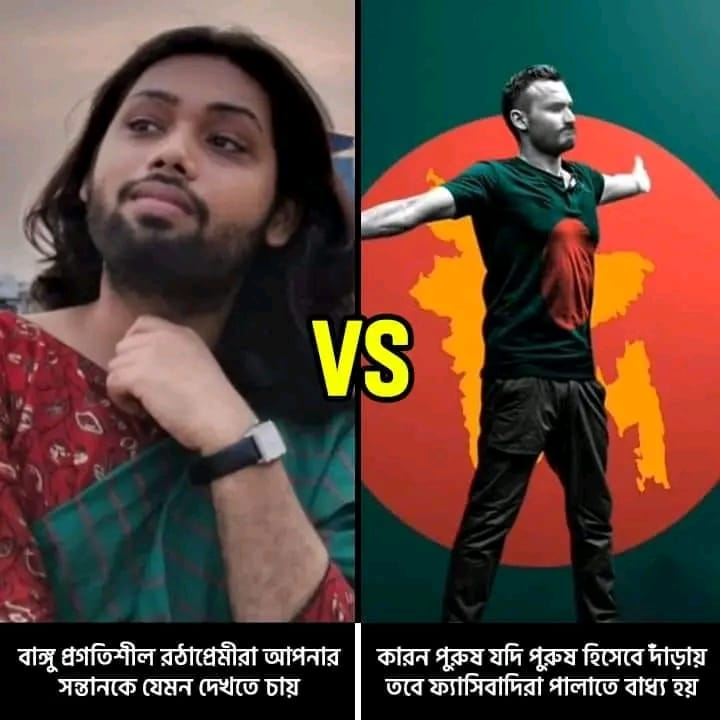
Because of the primacy of Facebook and Visual content23 in the Bangla Language GSM content arena, I maintain an anonymous Gay Meme Page on Facebok as ‘user research control’24 since February 2024 (‘Queer ইয়েz for বাঙালিGayz’ (Queer Yayz for Bengali Gayz), 8.5K followers) with recent extensions of the same to Instagram and Twitter (currently x.com).
Thus my primary archive is hundreds of memes and video clips bookmarked and taxonomised from relevant Facebook users’ feeds.
To complement the visual culture archive, a first degree Bangla language text-only Twitter (X) data mining exercise via combinations of relevant GSM keywords through DiscoverText (https://app.discovertext.com/) has created an organised database of 14,367 relevant tweets.
Weekly Google News Alerts for ‘সমকামী’ (Homosexual) – set up since January 29, 2024 supplemented by the post-Uprising buzzword alerts of ‘বৈষম্য বিরোধী ‘ (Anti-discrimination) and ‘সমন্বয়ক’ (Coordinator) set up since August 6, 2024 have created a database of about 550 (and growing) relevant content URLs from the non-platformised, non-social media locations of Bangla Language Internet.
A work-in-progress journal paper on the first case study mentioned above, titled ‘Transphobic ‘Sharif / Sharifa’ Controversy in Bangladesh : How local is it when it is online? ‘ has already been presented at ISSH 2024.25
End Notes
1. Gender and Sexual Minorities
2. In a private online conversation, Muhin Hashmi (pseud.) informed that it was historically one of his most-attacked posts among his highly censored and censured explicit homoerotic humourous story posts.
https://www.facebook.com/profile.php?id=100013820115921
3. Here I use the terminology of ‘Manosphere’ in a more diffused misogynistic and masculinist sense in this specific context. See Ribeiro et al. (2021) to understand how it spread everywhere online.
4. See https://www.equaldex.com/
5. Kanuha, V.K., 1999. The Social Process of” Passing” to Manage Stigma: Acts of Internalized Oppression of Acts of Resistance?. J. Soc. & Soc. Welfare, 26, p.27.
6. pp. 8-11. Chowdhury, N.S., 2020. Paradoxes of the popular: Crowd politics in Bangladesh. Stanford University Press.
7. For more context, see Chapter 11: ‘Digital Bangladesh’: Technology, Inequality and Social Change by AJM Shafiul Alam Bhuiyan in Shoesmith, B. and Genilo, J.W. eds., 2013. Bangladesh’s changing mediascape: From state control to market forces. Intellect Books.
8. See a summary of young student’s online role in BDR Mutiny in 2009, the Shahbagh Mass Protests in 2013, the Student protests against Tax on Education in 2015, and Road Safety Protest Movements in 2018 in Rashid, M. M., 2022. “Queer Blogs and Digital Archives: A Tactical Shift towards Queer Utopia in Bangladesh.” Media Fields Journal: Critical Explorations in Media and Space. 17 (2022): 1-11.
9. Anjum, S. 2024. “From Social Media to the Streets: How Bangladesh’s Gen-Z Movement Overcame Internet Shutdowns to Overthrow an Autocrat”, Techpolicy.Press, Published on
10. https://en.wikipedia.org/wiki/Anti-discrimination_Students_Movement
11. The Xulhaz-Tonoy killing in 2016 set back the online GSM expression in Bangladesh severely. https://en.wikipedia.org/wiki/Xulhaz_Mannan
12. See Gopinath, G., 2018. Unruly visions: The aesthetic practices of queer diaspora. Duke University Press.
13. See https://masculinities.srhr.org/homepage
14. See Van Dijck, J., 2009. Users like you? Theorizing agency in user-generated content. Media, culture & society, 31(1), pp.41-58.
15. Myles, D., Duguay, S. and Echaiz, L.F., 2023. Mapping the social implications of platform algorithms for LGBTQ+ communities. Journal of Digital Social Research, 5(4), pp.1-30.
16. Lin, Z., & Yang, L. 2020. A digital promised land? Digital landscape as a heterotopia for disabled people in China. Information, Communication & Society, 23(8), 1220–1234. https://doi.org/10.1080/1369118X.2020.1776366
17. On the aesthetics and politics of queeer mediatized dystopia / utopia, see Wholey, K., 2024. Queer Digital Culture: How Social Media Creates Queer Forms (Doctoral dissertation, Northeastern University).
18. Brock, A., 2018. Critical technocultural discourse analysis. New Media & Society, 20(3), pp.1012-1030.
19. With over 237 million native speakers and another 41 million as second language speakers as of 2024 (Ethnologue, 27th ed., 2024) , Bengali is the fifth most spoken native language and the seventh most spoken language by the total number of speakers in the world. It is the fifth most spoken Indo-European language.
Bengali is the official, national, and most widely spoken language of Bangladesh, with 98% of Bangladeshis using Bengali as their first language. It is the second-most widely spoken language in India.
20. Budhiraja, S., S.T. Fried, and A. Teixeira (2010) ‘Spelling it out: From alphabet soup to sexual rights and gender justice 1’, in Development, Sexual Rights and Global Governance. London: Routledge, pp. 131–144.
21. Bonini, T. and Treré, E., 2024. Algorithms of Resistance: The Everyday Fight Against Platform Power. MIT Press.
22. See Oguri, K., 2015. PhD Thesis. Sexual Occidentation and Its Consequences in LGBT Rights Politics: Reverse Orientalism, Homonationalism and Postcolonial Homophobia.
23. Chowdhury, MD Saiful Alam & Begum, Monira & Shaon, Shaolin. (2019). Impact of Social Media Visuals on People’s Visual Communication during Social Movements in Bangladesh. Global Journal of Human-Social Science. 9-18. 10.34257/GJHSSAVOL19IS11PG9.
24. See Brubaker, P. J., Church, S. H., Hansen, J., Pelham, S., & Ostler, A. (2018). One does not simply meme about organizations: Exploring the content creation strategies of user-generated memes on Imgur. Public relations review, 44(5), 741-751.
25. 3rd International Conference on Innovations in the Social Sciences and Humanities at Ton Duc Thang University, Ho Chi Minh City, Vietnam 26-27 July 2024 ).
Bibliography
Anjum, S. 2024. “From Social Media to the Streets: How Bangladesh’s Gen-Z Movement Overcame Internet Shutdowns to Overthrow an Autocrat”, Techpolicy.Press, Published on
Alam, P. and Marston, C. 2023. ‘“People are having lots of other kinds of sex”: Exploring sexual lifeworlds of LGBTQ+ young people in Bangladesh’, Cogent Social Sciences, 9(1). doi: 10.1080/23311886.2023.2185305.
Bonini, T. and Treré, E., 2024. Algorithms of Resistance: The Everyday Fight Against Platform Power. MIT Press.
Brock, A., 2018. Critical technocultural discourse analysis. New Media & Society, 20(3), pp.1012-1030.
Brunn, S.D., 1998. The Internet as’ the new world’ of and for geography: speed, structures, volumes, humility and civility. GeoJournal, 45(1/2), pp.5-15
Budhiraja, S., S.T. Fried, and A. Teixeira (2010) ‘Spelling it out: From alphabet soup tosexual rights and gender justice’, in Development, Sexual Rights and Global Govern#ance. London: Routledge, pp. 131–144.
Butler, Judith, 2024. Who’s Afraid of Gender?. Knopf Canada.
Caliandro, A., Gandini, A., Bainotti, L. and Anselmi, G., 2024. The platformization of consumer culture: A theoretical framework. Marketing Theory, p.14705931231225537.
Chowdhury, MD Saiful Alam & Begum, Monira & Shaon, Shaolin. (2019). Impact of Social Media Visuals on People’s Visual Communication during Social Movements in Bangladesh. Global Journal of Human-Social Science. 9-18. 10.34257/GJHSSAVOL19IS11PG9.
Chowdhury, N.S., 2020. Paradoxes of the popular: Crowd politics in Bangladesh. Stanford University Press.
Elkins, E., 2019. Locked out: Regional restrictions in digital entertainment culture (Vol. 14). NYU Press.
Hassan, M., 2022. An exploratory look into the increasing visibility of queer-themed content: Dhaka-based, youth-dominated social media platforms.dspace.bracuac.bd
Karim, S., Politics of identities: Problematics of categories, labels and languages in LGBTQI+ movement in Bangladesh. In Gender, Sexuality and Social Justice (pp. 165-186). Routledge.
Lin, Z., & Yang, L. 2020. A digital promised land? Digital landscape as a heterotopia for disabled people in China. Information, Communication & Society, 23(8), 1220–1234. https://doi.org/10.1080/1369118X.2020.1776366
Makoni, S., Kaiper-Marquez, A. and Mokwena, L. eds., 2022. The Routledge Handbook of Language and the Global South-s. London: Routledge.
Mazhar, Farhad .2012. “সন্ত্রাস, আইন ও ইনসাফ”, ফরহাদ মাজহার নির্বাচিত প্রবন্ধ, আগামী প্রকাশনী (“Terror, Violence, Law and Justice”, Farhad Majhar’s Collected Essays, Agami Prokashoni), pp. 102-103
Md. Sayeed Al-Zaman (2021): Are social media users becoming more visually biased?, Media Asia, DOI: 10.1080/01296612.2021.1966577
Monea, A., 2023. The digital closet: How the internet became straight. MIT Press.
Mukherjee, R. and Nizaruddin, F., 2022. Digital platforms in contemporary India: The transformation of quotidian life worlds. Asiascape: Digital Asia, 9(1-2), pp.5-18.
Nova, F.F., Saha, P. and Guha, S., 2022, June. Understanding online harassment and safety concerns of marginalized LGBTQ+ populations on social media in Bangladesh. In Proceedings of the 2022 International Conference on Information and Communication Technologies and Development (pp. 1-5).
Nova, F.F., DeVito, M.A., Saha, P., Rashid, K.S., Roy Turzo, S., Afrin, S. and Guha, S., 2021. ” Facebook Promotes More Harassment” Social Media Ecosystem, Skill and Marginalized Hijra Identity in Bangladesh. Proceedings of the ACM on Human-Computer Interaction, 5(CSCW1), pp.1-35.
Oguri, K., 2015. PhD Thesis. Sexual Occidentation and Its Consequences in LGBT Rights Politics: Reverse Orientalism, Homonationalism and Postcolonial Homophobia.
Ozbilgin, M.F., Erbil, C., Baykut, S. and Kamasak, R., 2023. Passing as resistance through a Goffmanian approach: Normalized, defensive, strategic, and instrumental passing when LGBTQ+ individuals encounter institutions. Gender, Work & Organization, 30(3), pp.862-880.
Puar, J.K., 2018. Terrorist assemblages: Homonationalism in queer times.Duke University Press.
Postill, J., 2008. Localizing the internet beyond communities and networks. New Media & Society, 10(3), pp.413-431.
Rashid, M. M., 2023. “Queering Bangladeshi Blogging Networks: Legal Rights, Religious Fundamentalism, and the Politics of Blog Publics in Bangladeshi LGBTQ+ Activism.” QED: A Journal in GLBTQ Worldmaking 10, no. 2 (2023): 93-117an, M., 2014. Queer rights and the triangulation of Western exceptionalism. Journal of Human Rights, 13(3), pp.274-289.
Rashid, M. M., 2022. “Queer Blogs and Digital Archives: A Tactical Shift towards Queer Utopia in Bangladesh.” Media Fields Journal: Critical Explorations in Media and Space. 17 (2022): 1-11.
Roy, G., 2024. Quota Reform Movement, Internet Shutdown and Economic Shock: Bangladesh in July, 2024. Internet Shutdown and Economic Shock: Bangladesh in July.
Ribeiro, M.H., Blackburn, J., Bradlyn, B., De Cristofaro, E., Stringhini, G., Long, S., Greenberg, S. and Zannettou, S., 2021, May. The evolution of the manosphere across the web. In Proceedings of the international AAAI conference on web and social media (Vol. 15, pp. 196-207).
Shoesmith, B. and Genilo, J.W. eds., 2013. Bangladesh’s changing mediascape: From state control to market forces. Intellect Books.
Whose Knowledge? State of the Internet’s Languages Report, 2024. https://internetlanguages.org/en/
 বাংলা Online Platform Queer কন্টেন্ট